



What Are Cacao Polyphenols And Flavonoids?
Polyphenols are plant based compounds which are well known for antioxidant properties as well as their various anti-inflammatory, neuro-protective, and cardio-protective properties. Flavonoids are a sub group of polyphenols which have been extensively researched for their benefits. When cacao is minimally processed to keep these compounds intact, it is a phenomenal source of dietary flavonoid compounds as well as non-flavonoid polyphenols.
Ora Cacao's entire process is designed around pure 100% cacao and protecting cacao's polyphenolic compounds. We convert organic cacao beans into 100% cacao that is ready to eat or make drinking chocolate with. We use LC/MS-MS lab testing to validate our low temperature process of making ceremonial cacao to ensure we provide you with cacao that has quantifiable health benefits.
What Do Ora's Polyphenol Test Results Show?
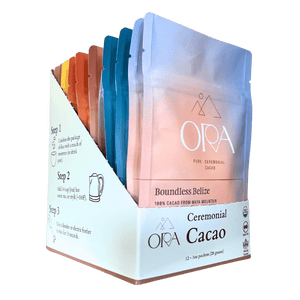
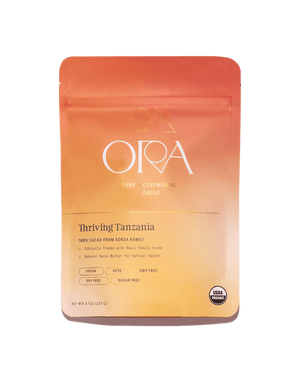
To date, we've tested Boundless Belize and Thriving Tanzania to better understand the polyphenolic compounds in our cacao and how they are affected by manufacturing. In fall 2026 we will be retesting both of these cacaos, as well as adding Glowing Guatemala, Illuminating India, and Uplifting Uganda to broaden our understanding.
Our Boundless Belize test results show 764mg flavonoids per serving, and Thriving Tanzania contains 674mg flavonoids per serving. These are notably high compared to other chocolate products, and are similar to values used in studies for verifying health benefits from flavonoids.
Our testing so far shows that over 80% of the original flavonoids and polyphenol compounds present in raw cacao beans remain intact in our finished ceremonial cacao. This compares very favorably to the substantial losses seen in conventional high-heat processing, and explains why our final flavonoid levels are so much higher than conventional chocolate products.

How Do Ora Cacao's Flavonoid Levels Correlate to Researched Health Benefits?
Correlating our lab test data to recent scientific studies shows that the flavonoid levels in a typical serving of Ora Cacao are very close to the “high flavonoid” protocols using standardized extracts in studies to establish positive health outcomes from consuming cacao flavonoids.
Cacao flavonoids are already known to improve cardiovascular function in patients with cardiovascular disease or at high risk. New studies now show a daily intake of 900mg of cacao flavonoids within one month can improve cardiovascular health even in low-risk, healthy men and women aged 35-60 years.
In the study, measurements of vasodilation, blood pressure, and plasma lipids enabled calculation of cardiovascular risk factors amongst 100 individuals.
Notably, blood pressure (BP) readings improved from an average of 126/79 mmHg to 121/75 mmHg, which is significant because BP increases with age and BP is directly correlated to cardiovascular and overall mortality.
Measurements of cardiovascular stiffness decreased toward values usually seen in people several years younger. Furthermore there was a 22% increase in blood vessel function, a reduction in LDL cholesterol, and an increase in HDL (good) cholesterol.
As a result, the 10 year Coronary Heart Disease (CHD) & Cardiovascular Disease (CVD) risks declined by 18% and 20%, and death risk by CHD & CVD declined by 50% and 40%. The 10 year heart attack risk also declined by 38%. There was no statistically significant reduction in stroke risk.
What Are The Flavonoid Compounds in Cacao?
Our lab testing has revealed numerous flavonoid and polyphenol compounds in our ceremonial cacao. We've identified roughly 60 flavonoid compounds (plus or minus a few depending on the cacao).
Across both cacaos tested, the top 10 flavonoids identified are:
- myricetin
- isovitexin
- luteoloside (luteolin 7-glucoside)
- procyanidin C1
- hyperoside
- delphinidin-3-O-glucoside
- catechin and epicatechin
- procyanidin B1
- quercetin-7-O-glucopyranoside
- procyanidin B3
What Are Cacao Flavonoid Health Benefits?
Here's a summary by the top 5 categories of cacao flavonoids from our lab test results.
Flavonols (myricetin, hyperoside, quercetin-7-glucopyranoside) — the most antioxidant-potent subclass. Myricetin, which had the highest concentration in our results, has been studied for cardiovascular protection, neuroprotection, anti-diabetic effects, and inhibiting LDL oxidation. Hyperoside and quercetin glycosides share similar cardioprotective and anti-inflammatory mechanisms.
Flavones (isovitexin, luteoloside) — primarily anti-inflammatory and neuroprotective. Isovitexin has been studied for anxiolytic effects, liver protection, and oxidative stress reduction. Luteolin (the aglycone of luteoloside) is one of the most researched flavones for neuroinflammation and metabolic health.
Proanthocyanidins / Procyanidins (procyanidin C1, B1, B3) — the class of compounds most associated with cacao's cardiovascular benefits. They improve endothelial function and nitric oxide bioavailability, which drives vasodilation and blood pressure reduction. Procyanidin C1 has also emerged as a promising senolytic compound — able to selectively clear aging senescent cells.
Flavan-3-ols (catechin) — the foundational cacao compound family. Closely related to epicatechin, catechins improve cerebral blood flow, cardiovascular function, and insulin sensitivity, and have prebiotic effects on gut microbiota.
Anthocyanins (delphinidin-3-O-glucoside) — the pigment compounds most associated with blueberries and dark berries. Delphinidin specifically has been studied for cardioprotection, anti-inflammatory effects, and neuroprotection.

What Are The Non-Flavonoid Polyphenol Compounds in Cacao?
Beyond just the subgroup of cacao flavonoids, non-flavonoid polyphenols in cacao offer numerous health benefits. We've identified roughly 50 non-flavonoid polyphenol compounds (plus or minus a few depending on the cacao).
Across both cacaos tested, the top 10 non-flavonoid polyphenols identified are:
- vanillic acid 4-β-D-glucopyranoside
- trans-cinnamic acid
- gentisic acid
- protocatechuic acid
- benzoic acid
- 3,4-dihydroxybenzaldehyde
- tyrosol
- 3-phenyllactic acid
- chlorogenic acid
- 4-hydroxyphenylacetic acid
What Are The Non-Flavonoid Polyphenol Health Benefits of Cacao?
Cacao is so much more than a flavonoid delivery vehicle. Non-flavonoid cacao polyphenols work through independent biochemical pathways, with different receptor interactions, different antioxidant mechanisms, and different microbial metabolism in the gut. The non-flavonoid polyphenols in cacao are often overlooked, even though they offer health benefits that are complementary, not redundant, with cacao flavonoids. Here's a summary by the top 3 categories of non-flavonoid cacao polyphenols.
1) Hydroxybenzoic acids (protocatechuic acid, gentisic acid, vanillic acid derivatives) - protocatechuic acid research shows antioxidant, anti-inflammatory, and potential neuroprotective effects. Gentisic acid has shown protective effects against atherosclerosis and inflammation. Vanillic acid derivatives are associated with anti-inflammatory and cardiovascular benefits.
2) Hydroxycinnamic acids and esters (trans-cinnamic acid, chlorogenic acid) — chlorogenic acid is one of the most researched polyphenols in any food, associated with improved glucose metabolism, reduced blood pressure, and cardiovascular protection. It's best known from coffee research but is present in cacao in meaningful amounts.
3) Simple phenols (tyrosol, 4-hydroxyphenylacetic acid, 3-phenyllactic acid) — tyrosol is the same antioxidant compound associated with the cardiovascular benefits of olive oil. 4-Hydroxyphenylacetic acid is a gut microbiome metabolite, meaning it interacts favorably with intestinal bacteria, supporting digestive and systemic health.
What Makes Cacao Polyphenols Most Bioavailable?
Polyphenol bioavailability depends heavily on the surrounding compounds that facilitate or impede absorption. Ceremonial cacao retains the natural cacao butter, fiber, and co-factors present in the cacao bean, which research suggests supports more complete polyphenol absorption unlike the manufacturing of cacao powder or various isolated flavonoid extracts. This is why ceremonial cacao has nothing added or removed from the cacao bean, it is the whole food form of cacao for maximum health benefits and it provides the optimal delivery mechanism for cacao polyphenols.
References
- Sansone R et al. (2015). Cocoa flavanol intake improves endothelial function and Framingham Risk Score — the Flaviola Health Study. British Journal of Nutrition.
- Heiss C et al. (2015). Impact of cocoa flavanol intake on age-dependent vascular stiffness. Age.
- Payne MJ et al. (2010). Impact of fermentation, drying, roasting, and Dutch processing on flavonoid content of cacao. Journal of Agricultural and Food Chemistry.
- Oracz J et al. (2017). From Cocoa to Chocolate: Impact of Processing on Antioxidant Activity. Oxidative Medicine and Cellular Longevity.
- Semwal et al. (2016). Activity of myricetin and other plant-derived polyhydroxyl compounds in human LDL and human vascular endothelial cells against oxidative stress. Food & Chemical Toxicology.
- Guo et al. (2024). Efficacy of Myricetin Supplementation on Glucose and Lipid Metabolism: A Systematic Review and Meta-Analysis.Nutrients.
- Łażewska et al. (2021). Myricetin as a Promising Molecule for the Treatment of Post-Ischemic Brain Neurodegeneration.Antioxidants.
- Dower et al. (2015). Effects of the pure flavonoids epicatechin and quercetin on vascular function and cardiometabolic health: a randomized, double-blind, placebo-controlled, crossover trial.American Journal of Clinical Nutrition.
- Xu et al. (2021). The flavonoid procyanidin C1 has senotherapeutic activity and increases lifespan in mice.Nature Metabolism.
- Masella et al. (2020). New progress in the pharmacology of protocatechuic acid: A compound ingested in daily foods and herbs frequently and heavily.Pharmacological Research.
- Zhao et al. (2021). Cardiovascular protection effect of chlorogenic acid: focus on the molecular mechanism.Frontiers in Pharmacology.
- Watanabe et al. (2014). The effect of chlorogenic acid on blood pressure.Clinical and Experimental Hypertension.
- Giamarellos-Bourboulis et al. (2019). Cardiovascular benefits of tyrosol and its endogenous conversion into hydroxytyrosol in humans: a randomized, controlled trial.European Journal of Clinical Nutrition.
Frequently Asked Questions
How many milligrams of flavonoids does Ora Cacao contain?
How many milligrams of flavonoids does Ora Cacao contain?
How does cacao support heart health?
How does cacao support heart health?
Does cacao processing destroy cacao flavonoids and polyphenols?
Does cacao processing destroy cacao flavonoids and polyphenols?
What are cacao flavonoids and why do they matter?
What are cacao flavonoids and why do they matter?
What is myricetin and why is it the top flavonoid in Ora Cacao?
What is myricetin and why is it the top flavonoid in Ora Cacao?
What are procyanidins and why are they important in cacao?
What are procyanidins and why are they important in cacao?
What non-flavonoid polyphenols does cacao contain?
What non-flavonoid polyphenols does cacao contain?
What are the health benefits of non-flavonoid polyphenols in cacao?
What are the health benefits of non-flavonoid polyphenols in cacao?
How are cacao polyphenols best absorbed by the body?
How are cacao polyphenols best absorbed by the body?