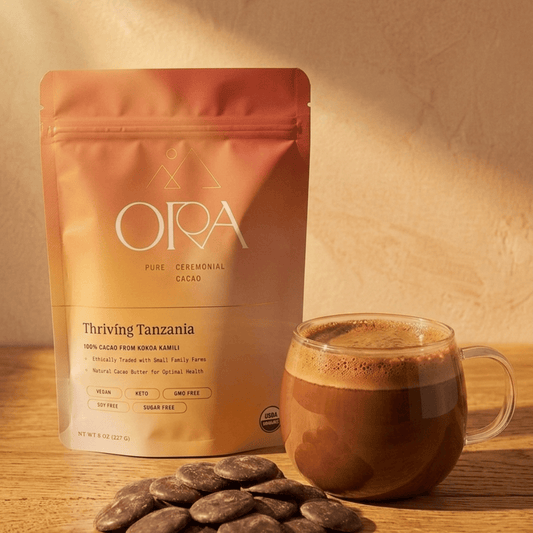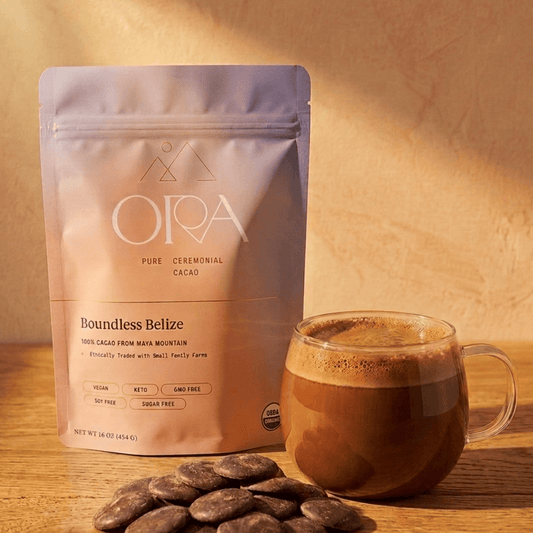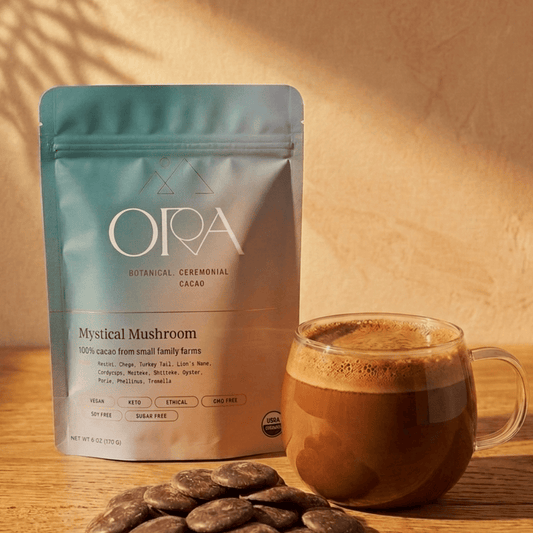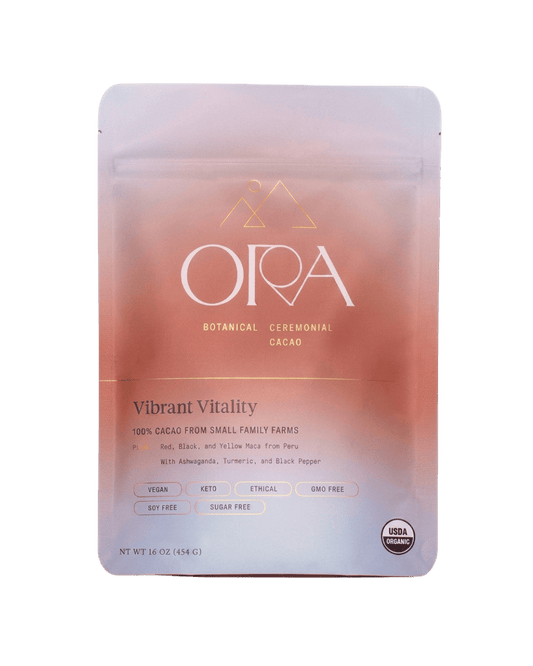





Most chocolate today is produced through systems optimized for speed rather than care, where rainforests are cleared, cacao is grown on monoculture farms, and farmers are incentivized for quantity of cacao beans harvested instead of quality.
Ceremonial cacao, as we have come to define it, begins with a different orientation, asking how cacao can grow regeneratively in tropical rainforest ecosystems and what becomes possible when farmers are genuinely supported. (Not all ceremonial cacao is regeneratively grown, so be sure to look into this when purchasing your cacao!). When sourcing changes at the root, everything downstream shifts, from ecology to livelihoods to flavor, and even the way cacao feels in the body.
Keep reading to explore why regenerative agroforestry, genetics, fermentation practices, and ethical, direct trade changes your cacao.
Shop Ceremonial Cacao
Cacao Is an Understory Tree, Not a Plantation Crop

Cacao is not meant to dominate a landscape. It is an understory tree, adapted to grow beneath a living rainforest canopy, roughly the size of an apple or orange tree, thriving in shade and biodiversity. More than half of all rainforest life exists above us in the canopy itself, an ecosystem that never touches the forest floor.
When cacao is grown regeneratively, that canopy remains intact. Forests stay alive. Biodiversity flourishes. Carbon is not released, it is actively drawn down. In fact, regenerative cacao grown in diverse agroforestry systems can have a net negative carbon impact, while monoculture cacao grown on cleared land contributes directly to deforestation and climate instability.
On smallholder farms, cacao grows alongside banana, plantain, avocado, spices, native medicinals, and food crops it has co-evolved with for generations. Farmers tend watersheds, build topsoil through chop-and-drop pruning, inoculate soil with beneficial fungi, and work with lunar cycles and natural airflow rather than chemicals.
These systems do more than reduce harm. They regenerate ecosystems over time, and cacao grown within a living forest carries a vitality that cannot be replicated on a plantation.
Genetics, Fermentation, and Why Quality Can’t Be Faked

Not all cacao carries the same aliveness. Much of the world’s commodity cacao is grown from cloned or heavily selected varieties bred for yield, uniformity, and disease resistance, not flavor, complexity, or resilience.
When cacao is allowed to cross-pollinate naturally, carry genetic diversity, and remain rooted in a specific place, it expresses depth. There is history in it. A relationship with land. An aliveness you can taste and feel.
Fermentation is where that potential is either honored or lost. High quality cacao requires time to ferment, often five to seven days, for yeast and bacteria to transform the fruit sugars and develop nuanced flavor. Commodity systems do not reward that patience. Farmers are paid the same regardless of quality, so there is no incentive to invest the extra labor.
The result is under-fermented cacao with muted or defective flavor. At the factory level, there is only one solution. Beans are often over-roasted to mask defects, and additives like vanilla or sugar are commonly used to cover what remains. This is why most commercial chocolate tastes flat or bitter, and why additives are so common.
Quality cannot be engineered back in later. It must be protected from the beginning, in genetics, in fermentation, and in how farmers are valued for their care.
Shop Ceremonial Cacao
Transparency, Direct Trade, and Paying for Care

In commodity cacao, even if it’s organic or fair trade, traceability is rare. Beans from multiple regions and countries are blended together, sold by the ton, and stripped of story, accountability, and relationship. Even brands often do not know who grew the cacao they use.
Direct trade changes the structure entirely. Farmers sell cacao directly to locally owned fermentation centers that manage quality, fermentation, drying, and export under one roof. This shortens the supply chain, increases transparency, and allows farmers to be paid earlier, more consistently, and at higher prices.
This matters more than most people realize. In some cacao-growing regions, farmers do not even own the land they farm or the timber above it. Governments can extract tall hardwood shade trees without compensation, destroying the cacao trees beneath them. Combined with commodity prices below poverty level, farmers are forced into survival mode.
When farmers are paid for care and quality, especially through models like wet cacao purchasing, everything shifts. Farmers save time, earn more, invest back into their land, and spend more time with their families. Local fermentation centers create skilled jobs. Regional standards rise. Entire communities become more resilient.
When farmers are supported, cacao reflects that support, energetically, socially, and sensorially.
Every cup of cacao carries the conditions under which it was grown. Forest or plantation. Care or extraction. Transparency or obscurity.
Choosing cacao sourced in right relationship with land and people is not just a purchasing decision. It is participation in a different system, one rooted in regeneration rather than depletion. This is the system that we are working to create at Ora. Thank you for being part of it.