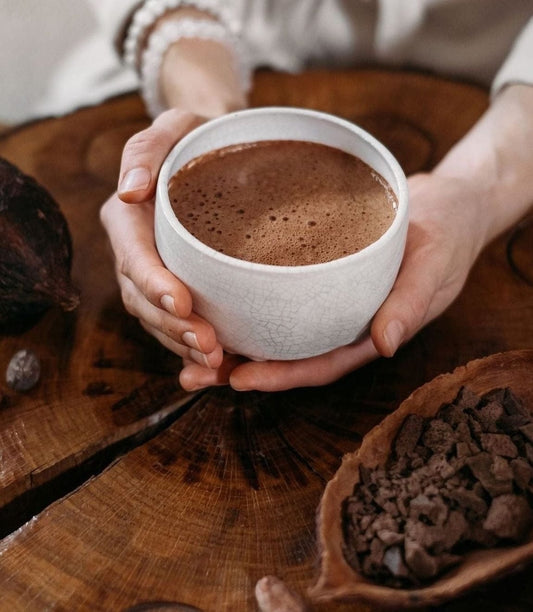


Many ceremonial cacao lovers report a notable impact on their mood. There is substantial science explaining why ceremonial cacao is so beneficial. Pure cacao contains beneficial neurotransmitters and neuro-modulators already present in our brain, and some of their precursors so the body can produce them. It also contains reuptake inhibitors which block the pathways our bodies normally use to break down and recycle these beneficial mood altering molecules, so the good mood lasts for longer.
In the long term, regularly working with ceremonial cacao can have therapeutic health benefits, including creating new neural pathways which change our daily experience to include more joy, love, and connection.
Top 5 Mood Active Molecules in Ceremonial Cacao
Below, we'll dive into five of the key compounds in ceremonial cacao which impact neurochemistry and mood. These are supported by many polyphenols and flavonoids that have broad benefits for cardiovascular and brain health.
Cacao & Anandamide — The Bliss Molecule
Anandamide is an endocannabinoid — a compound your brain produces naturally, named from the Sanskrit word ananda, meaning bliss. It binds to the same receptors as cannabis (CB1 and CB2), but it's something your body makes during states of joy, creativity, deep focus, and the famous "runner's high."
Cacao contains anandamide directly, and more importantly, it contains N-linoleoylethanolamine, a fatty acid that inhibits the enzyme that breaks anandamide down. The result: the anandamide your brain is already producing — as well as what you absorb from the cacao — lingers longer than it normally would. This is one of the key reasons people describe the cacao experience as expansive and blissful rather than stimulating.
Anandamide was the first endocannabinoid ever isolated, identified by Dr. Raphael Mechoulam's team in 1992 — the same researcher who first isolated THC. It plays a central role in pain modulation, appetite, memory, and mood regulation.
Cacao & Phenylethylamine (PEA) — The Excitement Molecule
Phenylethylamine (PEA) is sometimes called the "love molecule" because the brain releases it during romantic attraction, excitement, and states of intense focus. It sharpens alertness, creates the perception of time slowing down, and generates feelings of enthusiasm and drive.
The challenge with PEA on its own is that MAO-B, an enzyme in your gut and brain, breaks it down within seconds to minutes. This is why chocolate has been called an aphrodisiac for centuries but has never convincingly reproduced that effect in isolation — by the time it reaches the bloodstream, most of the PEA is gone.
Cacao's MAO inhibitors change this equation significantly. By slowing MAO-B, they extend the window during which PEA can act. The sense of heightened presence, excitement, and sharpened attention that many people feel during a ceremony is in large part PEA — allowed to do its work.
Cacao & Serotonin Pathways — Wellbeing and Stress Resilience
Cacao doesn't contain serotonin itself — serotonin can't cross the blood-brain barrier. What cacao contains is tryptophan, the amino acid precursor your body converts first to 5-HTP and then to serotonin in the brain. It also contains MAO-A inhibitors that slow the enzymatic breakdown of serotonin once it's produced, extending its mood-stabilizing effects.
Serotonin is closely associated with emotional equilibrium, stress resilience, and social warmth — qualities cacao drinkers consistently report. A 2018 review of mood compounds in cacao documented the neurochemical mechanisms behind these effects.
An important note for people on SSRIs or SNRIs: because cacao naturally raises serotonin levels through both precursor supply and reuptake inhibition, combining it with pharmaceutical SSRIs or SNRIs can stack their effects in a way that could cause serotonin syndrome, which can be toxic. If you're on these medications, please consult your prescribing physician before beginning a ceremonial cacao practice.
Cacao & Dopamine Pathways — Motivation and Pleasure
Cacao contains tyrosine, the amino acid precursor to dopamine (via L-DOPA). Dopamine governs motivation, the anticipation of reward, pleasure, and the drive to pursue goals. It's the molecule most associated with creative momentum and that sense of "I want to keep going."
Cacao's MAO-B inhibitors slow the breakdown of dopamine just as they do PEA, keeping levels elevated longer than they would be from the precursor alone. This is why cacao before a creative session, a meditation, or physical practice has such a devoted following — it's not a blast of stimulation, but a gentle, sustained lift in motivational chemistry.
Cacao & Theobromine — Sustained Energy Without the Crash
Theobromine is the primary alkaloid in cacao and the main driver of the "functional feeling" people experience — alert, focused, and calm without the spike-and-crash pattern of caffeine. Its name comes from Theobroma, the genus of the cacao tree, which translates as "food of the gods."
Theobromine is a methylxanthine, structurally similar to caffeine but with key differences:
- It has a longer half-life, producing a more gradual, sustained energy curve
- It does not cross the blood-brain barrier as readily as caffeine, so it stimulates the cardiovascular and bronchial systems without the same central nervous system (CNS) jolt
- It acts as a mild vasodilator, relaxing blood vessels and supporting blood flow — contributing to the warm, open feeling in the chest and body
- It stimulates without triggering the cortisol response that caffeine produces, which is why cacao rarely causes the anxiety or jitteriness associated with coffee
Pure ceremonial cacao contains far more theobromine than caffeine. This is the compound most responsible for why cacao feels like a functional tool rather than a stimulant.

How Does Ceremonial Cacao Affect Mood and How Long Do Effects Last?
When you drink ceremonial cacao you may feel expansive, blissful, connected to self and/or others, inspired, connected to your intuition & vision, connected to spirit, grounded, emotions arise, and the movement of stuck energy. Research on mood compounds in cacao documents the neurochemical mechanisms behind these effects.
You can also experience increased blood flow, mood elevation, and a more expanded state of consciousness. Cacao is a vasodilator, meaning your blood vessels and muscular systems relax. When working with ceremonial doses of cacao, research shows measurable increases in cerebral blood flow and peripheral vasodilation, meaning more blood is moving through your body and nourishing all of your systems.
Most people begin feeling cacao's effects within 20–45 minutes of drinking, as theobromine and neuro-modulating molecules are absorbed. The experience tends to peak around 60–90 minutes — this is when the combination of increased cerebral blood flow, anandamide activity, and PEA extension is most noticeable.
The active window for the peak experience is typically 2–4 hours, though this varies based on individual metabolism, body weight, dose, and whether you've eaten beforehand (food slows absorption). What lingers longest is theobromine, with a half-life of roughly 6–10 hours in most adults. This means the energy and vasodilatory effects from a morning ceremony can still be present in the early afternoon.
The long-term effects — neural pathway reinforcement, cumulative magnesium benefit, improved baseline mood — are the result of consistent daily or near-daily practice over weeks and months, not a single session.

Does Ceremonial Cacao Help with Depression?
Many people who struggle with mild to moderate depression or temporary challenging life events, but who are not on anti-depressant medications, turn to cacao to help stabilize their mood. The many active compounds in ceremonial cacao are very supportive for mood. Notably, cacao does not numb or suppress feelings, rather it helps people feel what's actually there by resourcing them. While feeling painful emotions can be challenging in the moment, it often leads to long term shifts and stabilization in mood.
Because cacao is contraindicated with SSRIs (as it could result in serotonin syndrome), many people who are on SSRIs for depression can't drink ceremonial cacao.
People may be able to partially reduce their SSRI medication intake and supplement with small amounts of ceremonial cacao, however medical studies on this need to be done to establish a verifiable protocol. Because pharmaceutical SSRIs have many side effects and ceremonial cacao is beneficial in so many other ways, we are hopeful such a protocol would greatly benefit the lives of many people struggling with depression and other mood disorders. We sincerely hope someday cacao could become a part of a clinically proven method for treating depression naturally, or as a method for assisting people in reducing their dependence on powerful pharmaceuticals.
Does Ceremonial Cacao Help with Anxiety?
Many people who struggle with anxiety find cacao very useful, and there are several scientific reasons behind this.
Magnesium is one of the most abundant minerals in pure cacao, and magnesium deficiency is strongly associated with increased anxiety, heightened cortisol response, and disrupted sleep. Magnesium modulates NMDA receptors involved in the stress response and plays a direct role in regulating the nervous system's baseline tone. Many modern adults are magnesium deficient, because a life style of coffee, alcohol, chronic stress, and lack of sleep all depletes Magnesium. Ceremonial cacao, consumed in ceremony-sized doses, provides a meaningful amount.
People who've abandoned coffee due to anxiety often find cacao gives them energy and focus without tipping into anxious territory. Many people with anxiety do poorly with caffeine because it activates the sympathetic nervous system and raises cortisol. Theobromine, cacao's primary alkaloid, produces sustained, mild stimulation without the cortisol spike.
Lastly the ceremony has a role that shouldn't be underestimated. The act of preparing cacao with intention, sitting with it, and creating space for internal experience is a form of structured mindfulness practice. Combined with cacao's vasodilatory and mood-supporting chemistry, practiced regularly ritual like this can have a regular calming effect.
Cacao is not a pharmaceutical anxiolytic and we don't position it as one. For some people, particularly at high doses, the increased heart rate from theobromine can feel uncomfortable or anxiety-adjacent. Starting with a smaller dose (half ceremony size, ~14g) is wise if you're sensitive to stimulants.

Cacao's Long Term Neural Pathway Benefits
Working with cacao regularly can result in long term beneficial changes in brain function, primarily through the reinforcement of neural pathways including more joy, love, presence, and connection. There is ample evidence for the neuroplasticity of the human brain, and regularly ingesting cacao with all of its beneficial neuromodulators and correlated reuptake inhibitors could have long term impact on dominant neural pathways.
Our founder Jonas consumes ceremonial cacao on the regular and has done so for nearly a decade. In this time he has logged dozens of occurrences of elevated consciousness not induced by cacao or any other input, but extraordinarily similar in nature to his experiences with cacao. Based on these correlations, he believes ceremonial cacao is a guide, showing our brains how to produce states of elevated consciousness and functioning, even without the ingestion of cacao. This is clearly anecdotal, and we strongly believe more long term studies are needed on the myriad health benefits of regular ceremonial cacao consumption.
References
- Nehlig A. (2018). Mood Components in Cocoa and Chocolate: The Mood Pyramid. Journal of Caffeine Research.
- Crichton GE et al. (2013). Cocoa polyphenols enhance positive mood states — RCT.
- Francis ST et al. (2008). Cerebral blood flow response to flavanol-rich cocoa.
- Spencer JP. (2009). Flavonoids and brain health.
- Sokolov AN et al. (2017). Enhancing Human Cognition with Cocoa Flavonoids.
Frequently Asked Questions
What molecules in cacao affect mood?
What molecules in cacao affect mood?
Does cacao increase serotonin?
Does cacao increase serotonin?
Can cacao interact with antidepressant medications?
Can cacao interact with antidepressant medications?
How does cacao affect blood flow to the brain?
How does cacao affect blood flow to the brain?
Does cacao support neuroplasticity?
Does cacao support neuroplasticity?
Is ceremonial cacao a psychedelic?
Is ceremonial cacao a psychedelic?
Does ceremonial cacao help with anxiety?
Does ceremonial cacao help with anxiety?
Does cacao help with focus and concentration?
Does cacao help with focus and concentration?
How long do cacao's mood effects last?
How long do cacao's mood effects last?
How much cacao do you need to feel the mood benefits?
How much cacao do you need to feel the mood benefits?