


Does cacao help with period pain?
If you’ve experienced chocolate cravings around your period, your body is probably craving the magnesium, mood lift, and energy boost which cacao naturally provides. Unfortunately, when we reach for chocolate bars with additives, sugar, or high levels of processing, the beneficial compounds in cacao are degraded and not as bioavailable.
Ceremonial cacao’s bioactive compounds are surprisingly supportive for common symptoms during your cycle: cramping, mood dips, and low energy. We’re excited to share the science of why this is.
The Historical Link Between Cacao and women's health
First we want to acknowledge ceremonial cacao’s centuries of historical use for supporting women’s health.
In the Mayan tradition, cacao is integrated into the birthing process. Some practices include a cacao preparation for the labor journey, and it has often been the first drink consumed by a mother and child after giving birth. We also know cacao was used in traditional Mayan practices to increase breast milk production.
Anecdotally, we learned from a researcher who spent over a decade studying cacao in Central America that women are traditionally the guardians of the cacao recipe, and are the only ones who prepare cacao beverages. For many centuries the link between cacao and women’s health runs deep.

Cacao & Period Cramps
There are two physical ways cacao helps relieve uterine cramping: flavanol content and high magnesium content.
1. Cacao Flavanols Ease Cramping
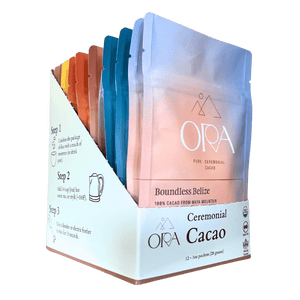
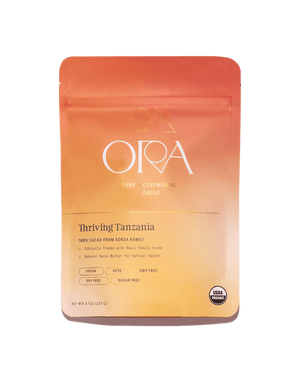
Cacao is one of the richest dietary sources of flavanols, plant compounds with a well-studied effect on blood vessels. The European Food Safety Authority concluded this: cocoa flavanols have a demonstrated cause-and-effect relationship with healthy blood vessel function, specifically helping blood vessels relax in a way that contributes to normal blood flow.(1) The effect was seen with 200 mg of cocoa flavanols a day. Our testing of two cacaos reveals that Boundless Belize has 764mg flavonoids per serving, and Thriving Tanzania contains 674mg flavonoids per serving.
In a small study, eating flavanol-rich chocolate also raised levels of prostacyclin, a compound which relaxes blood vessels.(2) Because reduced blood flow to the uterus is one of the drivers of cramping pain, cacao's ability to support circulation offers a plausible explanation for its effect but this hasn't yet been studied in the uterus directly.
The same study showed eating flavanol-rich chocolate lowered leukotrienes, lipid signaling molecules which trigger smooth muscle contraction, like those found in the uterus.(2) Early research has found elevated leukotriene levels in young women with painful periods.(3) Together, these findings indicate one more way cacao may ease cramping.
2. Magnesium helps muscles relax
Cacao is also a meaningful source of magnesium, a mineral essential for muscle relaxation. Magnesium helps muscles release after contracting.(4)
A Cochrane review found magnesium relieved menstrual pain better than placebo and reduced the need for additional pain medication, calling it a promising treatment.(5) A 2017 review of magnesium in gynecology similarly concluded magnesium supplementation is effective in preventing menstrual pain.(6) These studies used between 150 - 365mg of magnesium a day,(7) and one serving of ceremonial cacao has 52mg of magnesium. So the magnesium in ceremonial cacao helps contribute to cramp reduction and muscle relaxation but isn’t high enough on its own for uterine cramping relief.
Since magnesium supplementation can impact the digestive system and can create nausea or GI issues, we recommend a holistic, high-magnesium dietary approach during menstruation. Magnesium rich foods to consume, in addition to cacao, include: pumpkin seeds (150mg/oz), almonds (80mg/oz), quinoa (60mg ½ cup), and spinach (78 mg/ ½ cup). It’s helpful to know that zinc and calcium compete for the same absorption pathways as magnesium, so taking zinc or calcium supplements will reduce your ability to absorb magnesium from food.

Cacao & Energy Support
Low estrogen and progesterone also create fatigue and low energy. This is usually most intense in the days leading up to the first day of your period and the first few days of your period before these hormones begin to increase. Losing iron through blood is another cause of fatigue and exhaustion. Another way cacao helps relieve period symptoms is by providing sustained, gentle energy, mainly through theobromine instead of caffeine.
Coffee, Progesterone, & Cortisol
Here’s why you want to swap coffee for cacao right before and during your period. Progesterone breaks down into allopregnanolone, a calming compound which acts on the brain's GABA receptors to ease anxiety and help regulate the stress response. (8) (9)As progesterone drops in the days before a period this calming effect decreases, which can make stress feel more intense in your body.(9)
Caffeine raises cortisol, the body's main stress hormone,(10) so in the days before and during your period, coffee can amplify feelings of anxiety and fight-or-flight, without the buffer of stress regulation from progesterone.
Ceremonial cacao does contain a small amount of caffeine, 36mg compared with about 95 mg in a cup of coffee, but the effects are more slowly released due to naturally occurring fats. Most of cacao’s energy comes from theobromine, a milder stimulant which rises and fades more gradually. (11) (12)
How Theobromine Works
Theobromine is the primary alkaloid in cacao and the main driver of feeling energized, alert, focused, and grounded without the spike-and-crash pattern of coffee. Theobromine is a methylxanthine, structurally similar to caffeine but with key differences:
- It has a longer half-life, producing a more gradual, sustained energy curve
- It does not cross the blood-brain barrier as readily as caffeine, so it stimulates the cardiovascular and bronchial systems without the same central nervous system (CNS) jolt
- It acts as a mild vasodilator, relaxing blood vessels and supporting blood flow — contributing to the warm, open feeling in the chest and body
- It stimulates without triggering the cortisol response common with caffeine, which is why cacao rarely causes the anxiety or jitteriness associated with coffee
Cacao & Mood Support
During menstruation, your estrogen and progesterone dip to their lowest levels throughout the month. Estrogen supports serotonin activity in the brain. As estrogen levels drop, so does serotonin production, which impacts mood, energy levels, and sleep.
Progesterone is linked to systems regulating stress and emotional processing, so when progesterone is low, mood is negatively impacted. With these two hormones at their lowest, it is normal to feel an impact on mental health during menstruation. Another reason why you might find yourself reaching for chocolate during your period are its helpful mood lifting compounds.
We know ceremonial cacao contains beneficial neurotransmitters and neuro-modulators already present in our brain, and some of their precursors so the body can produce them. It also contains enzyme inhibitors which block the pathways our bodies normally use to break down and recycle these beneficial mood altering molecules, so the good mood lasts for longer. Below is an overview of some of the key mood lifting molecules in cacao.
Anadamide
Cacao contains anandamide, also known as the bliss molecule, and it also contains N-linoleoylethanolamine, a fatty acid which inhibits the enzyme that breaks anandamide down. Anadamide is one of the key reasons people describe drinking cacao as expansive and blissful.
Serotonin
Cacao doesn't contain serotonin itself — serotonin can't cross the blood-brain barrier. What cacao contains is tryptophan, the amino acid precursor your body converts first to 5-HTP and then to serotonin in the brain. It also contains MAO-A inhibitors which slow the enzymatic breakdown of serotonin once it's produced, extending its mood-stabilizing effects.
PEA
Phenylethylamine (PEA) is sometimes called the "love molecule" because the brain releases it during romantic attraction, excitement, and states of intense focus. It sharpens alertness, creates the perception of time slowing down, and generates feelings of enthusiasm and drive.
Cacao also contains MAO-B inhibitors which extend the experience of PEA.
Dopamine
Cacao contains tyrosine, the amino acid precursor to dopamine (via L-DOPA). Dopamine governs motivation, the anticipation of reward, pleasure, and the drive to pursue goals. It's the molecule most associated with creative momentum and the sense of "I want to keep going."
Cacao's MAO-B inhibitors slow the breakdown of dopamine just as they do PEA, keeping levels elevated longer than they would be from the precursor alone.

There are several mechanisms in cacao working simultaneously to help create more easeful periods.
Its flavanols support healthy blood flow, which may help ease the reduced circulation that contributes to cramping, and they lower inflammatory compounds linked to uterine contractions. Its magnesium content contributes to muscle relaxation and cramp relief. Its mood-related compounds may offer some support at a time when estrogen and progesterone are at their lowest. And because its energy comes mainly from theobromine rather than caffeine, it offers a gentler alternative to coffee on the days when your body's natural stress buffer is lowest.
It seems the science is catching up to the wisdom which we’ve heard anecdotally and probably what you’ve experienced first-hand of cacao creating more easeful periods.
References
- EFSA Panel on Dietetic Products, Nutrition and Allergies (NDA). Scientific opinion on the substantiation of a health claim related to cocoa flavanols and maintenance of normal endothelium-dependent vasodilation pursuant to Article 13(5) of Regulation (EC) No 1924/2006. EFSA Journal. 2012;10(7):2809. doi:10.2903/j.efsa.2012.2809
- Schramm DD, Wang JF, Holt RR, et al. Chocolate procyanidins decrease the leukotriene-prostacyclin ratio in humans and human aortic endothelial cells. American Journal of Clinical Nutrition. 2001;73(1):36–40. doi:10.1093/ajcn/73.1.36
- Harel Z, et al. Urinary leukotriene (LT) E4 in adolescents with dysmenorrhea: a pilot study. Journal of Adolescent Health. 2000;27(3):151–154. doi:10.1016/s1054-139x(00)00123-3
- Investigation of laboratory and clinical features of primary dysmenorrhea: comparison of magnesium and oral contraceptives in treatment. Cureus. 2022;14(11):e32028.
- Proctor ML, Murphy PA. Herbal and dietary therapies for primary and secondary dysmenorrhoea. Cochrane Database of Systematic Reviews. 2001;(3):CD002124.
- Parazzini F, Di Martino M, Pellegrino P. Magnesium in the gynecological practice: a literature review. Magnesium Research. 2017;30(1):1–7. doi:10.1684/mrh.2017.0419
- Fontana-Klaiber H, Hogg B. Therapeutic effects of magnesium in dysmenorrhea. Schweizerische Rundschau für Medizin Praxis. 1990;79(16):491–494.
- Wirth MM. Beyond the HPA axis: progesterone-derived neuroactive steroids in human stress and emotion. Frontiers in Endocrinology. 2011;2:19. doi:10.3389/fendo.2011.00019
- The role of the hypothalamic-pituitary-adrenal axis in depression across the female reproductive lifecycle: current knowledge and future directions. 2023. (Verify authors and journal on the source page.)
- Lovallo WR, Whitsett TL, al'Absi M, Sung BH, Vincent AS, Wilson MF. Caffeine stimulation of cortisol secretion across the waking hours in relation to caffeine intake levels. Psychosomatic Medicine. 2005;67(5):734–739.
- Mitchell ES, Slettenaar M, vd Meer N, Transler C, Jans L, Quadt F, Berry M. Differential contributions of theobromine and caffeine on mood, psychomotor performance and blood pressure. Physiology & Behavior. 2011;104(5):816–822. doi:10.1016/j.physbeh.2011.07.027
- Baggott MJ, et al. Psychopharmacology of theobromine in healthy volunteers. Psychopharmacology. 2013;228:109–118.
Frequently Asked Questions
Does cacao help with period cramps?
Does cacao help with period cramps?
How much magnesium is in ceremonial cacao, and is it enough for cramps?
How much magnesium is in ceremonial cacao, and is it enough for cramps?
Is cacao a better choice than coffee during my period?
Is cacao a better choice than coffee during my period?
Can cacao help with mood during menstruation?
Can cacao help with mood during menstruation?